Spotitube
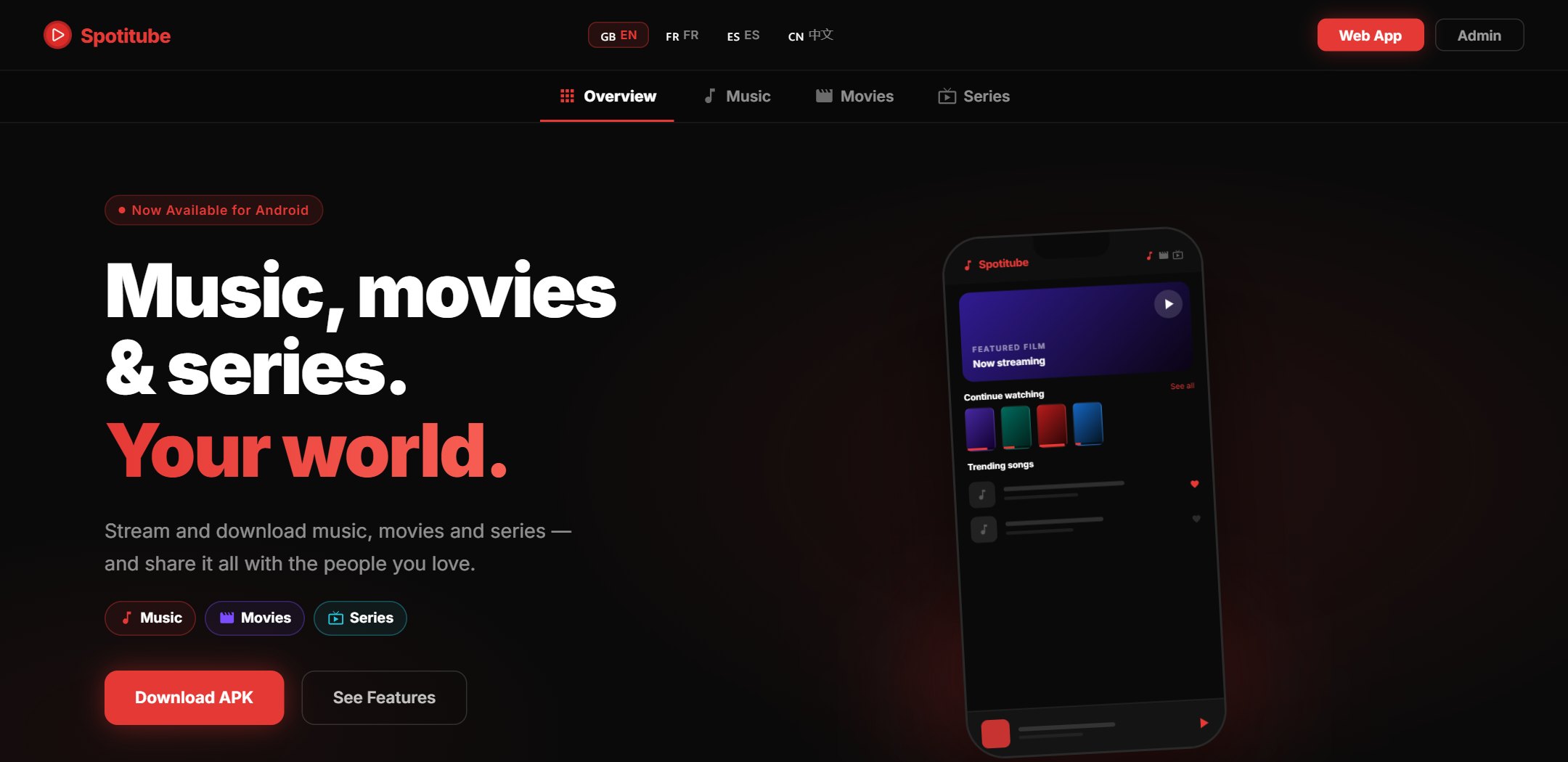
A social app for music, movies, and series on Android (YouTube-Music-style), with a tested web admin console and a hardened backend.
The problem
People want one social app to stream and save music, movies, and series, with a social layer and an admin side to manage content — most apps do only one of these.
What I built
A social app for music, movies, and series on Android with streaming, offline downloads, playlists, and discovery, plus a web admin console — and a backend hardened with tested security rules.
Architecture
Android + a web admin console, on a tested Firebase backend:
Highlights
- Music, movies, and series — streaming, offline downloads, playlists, and discovery in one app.
- A React + MUI admin console (TanStack Query, Recharts, PWA).
- Vitest tests on the Firestore security rules, with coverage and a CI script.
- Server-enforced user blocking, a security review, and a launch checklist.
The full story
The product
Spotitube is a social app for music, movies and series: stream and download, build playlists, follow friends, see what they're playing, and watch together. It ships as an Android app and a React web app, with a web admin console to run the catalogue, and a Firebase backend with Cloud Functions.
It is my most mature product — v1.4.3, about 920 commits, and a real test suite — and the one that taught me the most about running something, not just building it.
Architecture
- Android: a layered data / domain / UI app — Kotlin, Jetpack Compose, Hilt for dependency injection, Room, Retrofit and a Media3/ExoPlayer player.
- Web: React 18, TypeScript and Vite, with MUI and TanStack Query; the admin console adds Recharts, PWA support and i18n.
- Backend: Firebase Auth, Firestore, Storage and FCM, plus Cloud Functions for everything a client must not be trusted to do.
- Media: audio and video are served from Cloudflare R2 and a CDN rather than Firebase Storage.
One player UI, two engines
Films come from three sources — the CDN, a local download, or YouTube — and each platform plays them through two engines: a native player for CDN and local files, and an IFrame/WebView player for YouTube. The rule the whole player is built on is written into its contract: the UI never asks which engine it has. Each engine adapts itself to one shared state and control interface, and the shell consumes only that.
Before extending the player, I audited both engines against the code rather than from memory, and corrected the plan where it was wrong:
| Capability | CDN / local | YouTube |
|---|---|---|
| Precise seek | Yes | Coarse — snaps to keyframes |
| Time updates | Events | Polled — the IFrame API has none |
| Picture-in-picture | Yes | No — PiP is a <video> API |
| Background playback (Android) | Yes | No — it runs in a WebView |
| Works offline | Local files only | No |
One subscription, many devices
A subscription can be used on several devices, so something has to decide who keeps a seat and who gets locked out. That policy decides who pays, so I extracted it from the Cloud Functions entry point into its own module to test it without Firebase.
One detail shows the kind of thinking it needed: the app syncs on every launch and resume, and every write to a subscription re-fires the listener on every other device. So a session's heartbeat is persisted at most once an hour — far finer than the multi-day idle window it feeds, and without a write storm across devices.
Guarding a real budget
Some admin tools call the YouTube Data API, which allows 10,000 units a day and charges 100 units for a single search. An afternoon of enthusiastic searching can exhaust it, and when it runs out the error looks like a broken API key. The rate limits on those functions exist to make that impossible by accident — and to fail with a sentence that says what happened instead of sending someone off to debug a key that is fine.
Quality and security
- 139 test files across the web app (Vitest), Cloud Functions (Node's test runner) and Android (JUnit).
npm run ciruns the type-check, the tests and a production build; Firestore security-rule tests run on the emulator.- A security review (June 2026) covered Firestore rules, callable-function auth and Storage rules. It found that Storage rules existed only in the console — not in source control — and fixed it with owner-only, image-only, 5 MB-capped rules. It also flagged a one-off migration endpoint guarded by a token in its URL, with concrete options to remove it.
- Server-enforced user blocking replaced a client-side filter: Cloud Functions mirror each block, unfollow both ways and drop collaborations; Firestore rules enforce it for comments, rooms and mentions; rule tests cover it. Planned and shipped as a 7-day plan.
What's next
Today the paywall protects the apps, not the audio files themselves. The fix is fully designed and scheduled before public launch: a Cloud Function mints short-lived HMAC-signed URLs after checking the subscription and the device seat, and a Cloudflare Worker in front of a private bucket verifies them — with the cache key set to the path only, so every user still shares the same edge cache. It is not built yet, and I don't claim it is.
What I learned
- Extract the policies that cost money or lock people out, and test them in isolation.
- Audit what the code actually does before planning on top of it.
- Write errors for the person who will read them.